
You don't have an energy problem. You have an execution problem.
The savings are real, and the math usually works on paper. But the projects never make it to approval and execution. They sit in limbo, because no one owns the next step. This is a short guide to why that happens, and what it takes to actually get them built.
Most energy projects don't fail. They just never get started.
Walk any industrial site and you will find them. A maintenance engineer has a fix in the queue that nobody advances. A known billing error goes unclaimed for years. A fifty-thousand-dollar audit gathers dust in a drawer. None of these projects are bad.
They stall for the same reason every time: no one owns the next step, no one has the data or the proposal to justify it, and no one connects it to the money. The economics work. The execution doesn't.
A project in limbo is one that is economically attractive and technically sound, and going nowhere, because the path from "good idea" to "deployed and saving money" has no owner.
Rising costs make the limbo expensive. US electricity prices keep climbing, with the EIA reporting residential prices up roughly 7% year over year (and steeper increases in some wholesale and regional markets), partly driven by AI data center demand, and the last decade saw roughly twice as many weather-driven grid outages as the one before. Every stalled project is a bill you keep paying.
The market sells energy management as one of three things.
You will recognize all three. Each is useful. Each stops short of the thing you actually need, which is a project that gets built.
Notice the thread. At the end of all three, the work comes back to you. The study hands you a report. The dashboard hands you a list. The vendor hands you an invoice. Each makes a step easier without ever taking the step.
Which raises the real question: not what's wrong (your facilities or maintenance team probably already knows), but whether anyone will actually get the project built. That starts with your data.
Get the raw data centralized, and the projects qualify themselves.
It starts with your utility bills, but a bill is just one source. The fuller picture is all of your energy data in one place: utility bills and their line items, yes, but also interval and meter reads, demand and load profiles, rate and tariff schedules, operating hours, and the equipment on your floor, much of which you are already collecting for ESG and carbon reporting. Today it lives in a dozen systems, owned by no one and connected to nothing.
Gravity pulls that raw source data together, and everything we do to qualify a project comes from it. With the source data in one place, the project surfaces itself. It could be a solar array. It could be demand response. It could be power factor correction. It could be a sales tax refund. It could be LED lighting or motor soft starts. Scroll to watch one dataset unlock them.
Sales tax refund
Tax lines on the bill, plus a manufacturing facility type, reveal sales tax you never owed. Refunds can reach back years.
Rate tariff correction
Your demand and load profile, checked against every published tariff, exposes the wrong plan. Gravity builds a shadow bill to prove it.
Power factor correction
A low power factor reading or a KVAR charge points straight to capacitor banks. Payback in 12 to 36 months.
Demand response
Interval load and peak data, your operating schedules, equipment and load profile, and even site location together show which sites can get paid to curtail. Little to no capital, fast payback.
Solar & battery storage
Your full consumption and load profile sizes on-site solar and storage, then Gravity stacks federal and local incentives to make the economics work.
LED lighting & motor soft starts
Off-hours load and the equipment list surface lighting retrofits, motor soft starts, and vampire-load fixes.
Every one of these stems from the same thing: access to the raw source data, centralized. Without it, qualification is guesswork. A vendor without your interval data is estimating your demand-response value. A consultant without your tariff and load profile is guessing whether you are on the wrong rate. With the source data in one place, the answer is calculated, not assumed, and the project is real enough to take to finance.
Four teams, one building, no shared picture.
Sustainability, operations, facilities and maintenance, and finance each hold one piece. None holds the energy data that ties them together. Not everyone knows that demand response applies to their load, that battery storage could be lucrative, or that a new incentive opened up this month.
The knowledge is scattered, and these functions rarely talk to each other, so nothing happens. Centralizing the data is what lets one model see the whole picture, and one team act on it.
A platform and a team, operating as one.
The platform without the team is just reporting software. The team without the platform is just consulting. Together they carry a project from limbo to built, always starting from where you actually are: your data, your level of control, your budget, your approval process.
We are not here to replace your team or claim we know your sites better than they do. We extend it. We take on the legwork that stalls projects, the data, the proposals, the partners, and the tracking, so your people make the calls and your experts spend their time where judgment matters.

AI and software-enabled assessment
Ingest bills, cross-reference every published tariff, build shadow bills, flag anomalies. More thorough than the incumbents.
Pragmatic, customer-driven scope
We focus only on what you control and what clears your finance window. We do not boil the ocean or charge by the square foot to do it.
Engineers who kick the tires
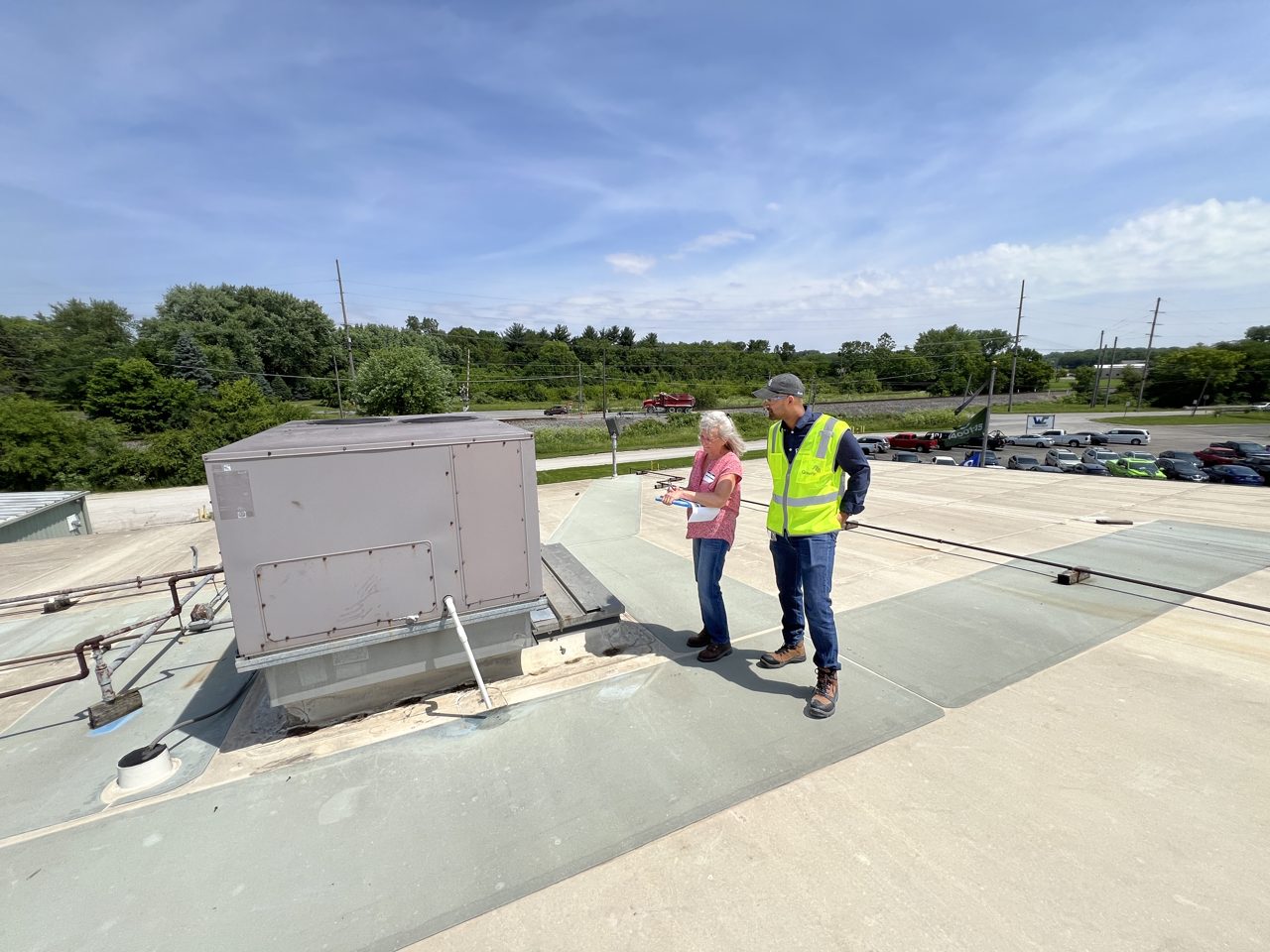
Beyond automatic qualification, our energy engineers confirm the state of play on the ground, and when a project calls for it they build an energy model of the site rather than running a generic checklist, so what we surface is genuinely deployable.
Closing the loop with the Energy Management Marketplace
We attach a financed, deployable solution to every issue we raise. Through Gravity's Energy Management Marketplace, which has deployed more than $20M in lifetime customer savings, we prequalify the project, generate an indicative quote, and match you with vetted implementation, financing, and incentive partners.
And every project lands in one source of truth, savings, emissions, and cash flow in one place, so the next project is easy to justify to whoever signs off.
We prioritize where you can actually act.
A traditional ASHRAE Level 2 or 3 audit covers the whole building and ends in a 50-page report that often sits on a shelf. The Gravity energy assessment is a Level 2-equivalent that deliberately skips what you can't change. We spend the time upfront with your plant manager and maintenance engineer to learn what you control and what you are likely to deploy, then focus there.
We gather more intel, not less.
We start from your utility and site data to qualify projects on day one, then go deeper into projects that span set-point optimization, compressed-air leak detection, and building controls. We are willing to install sensors and leave them in place to capture real operating data.
Lower cost to serve, more sites covered.
We used to rely on external energy engineers. We built the capability in-house so we can offer assessments at a significant discount and run them affordably across many sites. We have completed dozens in the past year.
Maintenance, the utility, and your facility team.
We partner with your maintenance engineer and facility team, and we often conduct the on-site assessment alongside your local utility rep to capture rebates and free programs. We also bring vendor partners into the on-site visit to parallelize the work and shorten the time to a proposal.
Tracked from idea to executed.
Every assessment, ours or one you have already done, gets pulled into the platform, turned into projects, attached to vendors, and tracked to completion in one place.
"Our partnership with Gravity has allowed us to mitigate rising electricity costs across our business. They helped us complete an onsite energy assessment, identify key energy efficiency opportunities, and take actions to reduce energy use."
Next to a typical incumbent
billing errors caught, with bill data extraction metered as a paid add-on.
billing errors caught. Extraction included.
Projects that actually got built.
The same projects that sat frozen at the top of this page are the ones Gravity moves. Across recapture and capital projects, anonymized enterprises and named customers.
After choosing Gravity over 14 other platforms, the team measured Scope 1 and 2 in five weeks, then enrolled three companies in demand response at zero upfront capital. Now moving toward solar and storage.
Read the case study →Deployed with Gravity's support. Roughly $2M in stacked federal and local incentives took a ~$1.7M system down to about $500k net, offsetting around 13% of the site's electricity. The panels even double as a passive thermal barrier, keeping the roof about 28°F cooler and cutting chiller load for roughly $25,000 a year nobody had modeled.
It started with a utility-bill diagnostic that recovered over $200k in sales taxes they had paid for years but were exempt from. From there: $300k+ a year in demand response earnings across their sites, and $200k+ in LED lighting and HVAC projects. One supplier, many project types, starting with the no-CapEx wins.
Cooling tower optimization across their facilities, identified by Gravity and deployed with no upfront capital and zero downtime.
"Demand response makes a great entry point into the world of energy and cost savings, followed by more capital-intensive projects like solar."
Start where you are.
A project that gets built is what moves your costs and your emissions targets. A report moves neither.
Bring one bill. Watch it work.
Drop a utility bill into our scanner and see the savings we can find, in seconds.
Scan a bill →Talk to our energy team.
Reach out to schedule time to discuss energy management for your sites.
Talk to an expert →