
Sustainability teams are small, but their work is broad. The same person reconciling utility bills one week is often preparing for an audit the next, and briefing executives the week after that.
That breadth makes expertise hard to build and easy to lose. New team members ramp slowly, hard won knowledge tends to live with one person, and questions that should take a few minutes end up waiting on expert advice.
This month's product update introduces Gravity Academy, a set of learning resources to build durable sustainability expertise, among other new releases.
Build Lasting Expertise with Gravity Academy
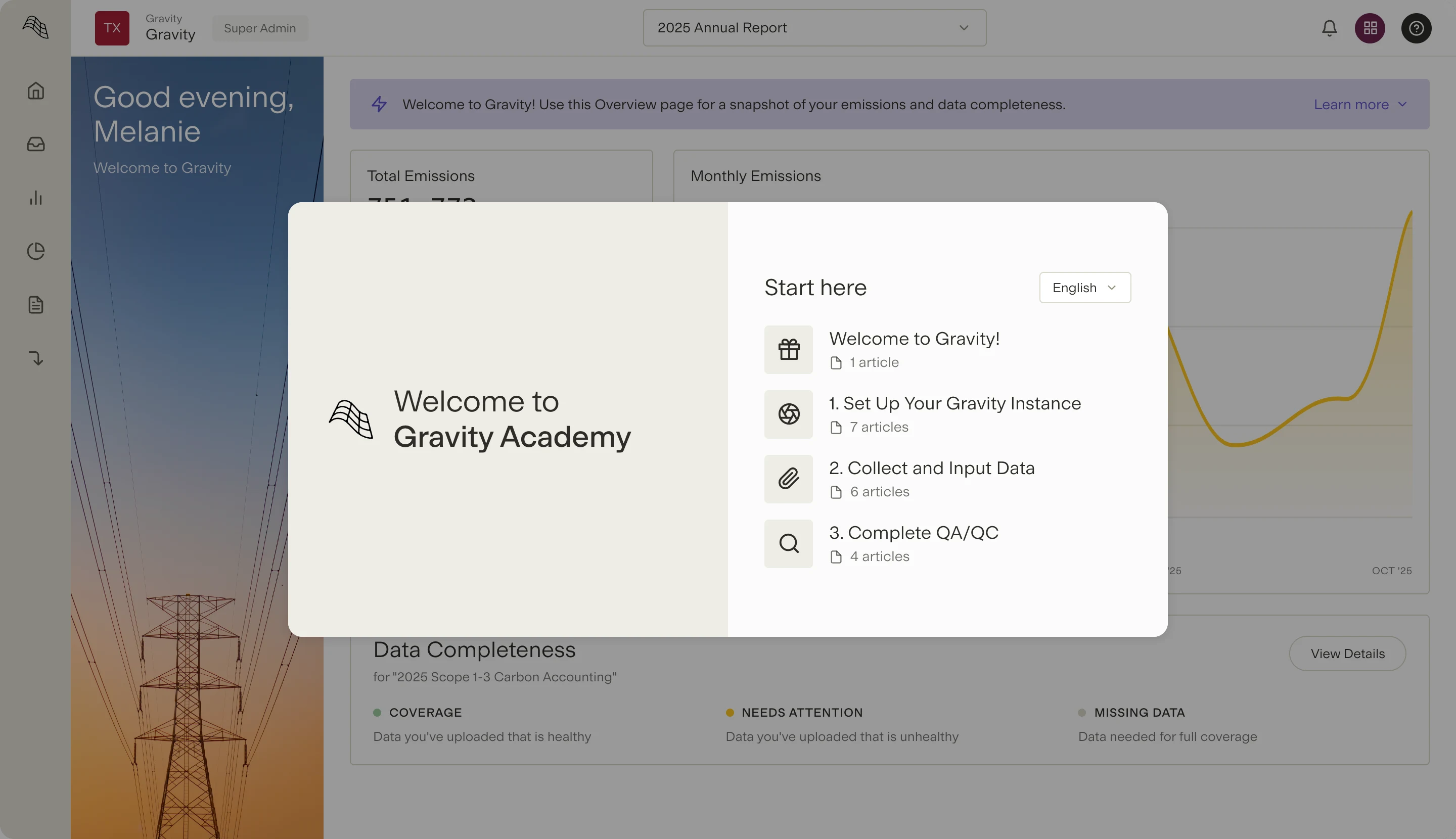
Software is only as useful as a team's fluency with it, and most sustainability professionals learn on the fly rather than through dedicated training. Gravity Academy pairs in-platform guidance with structured learning resources you can work through at your own pace:
- Learn without leaving your work. Guidance banners on key pages explain what to do next across core reports, sites, energy bills, fleets, utility integrations, and more.
- Find answers in seconds. The refreshed knowledge base is organized into modules covering setup, data collection, QA and QC, analysis, reporting, and supplier engagement. Open it from the question mark icon or from Settings.
- Confirm what you've learned. Optional comprehension checks at the end of modules let you test your understanding before moving on.
- Become a certified power user. Gravity 101, 201, and 301 courses blend written assessments with hands-on practice and live touchpoints with the Climate Strategy team. Ask your Climate Strategist to learn more.
- Share it in Spanish. The knowledge base is available in both Spanish and English.
Forecast Utility Spend Across Multiple Scenarios
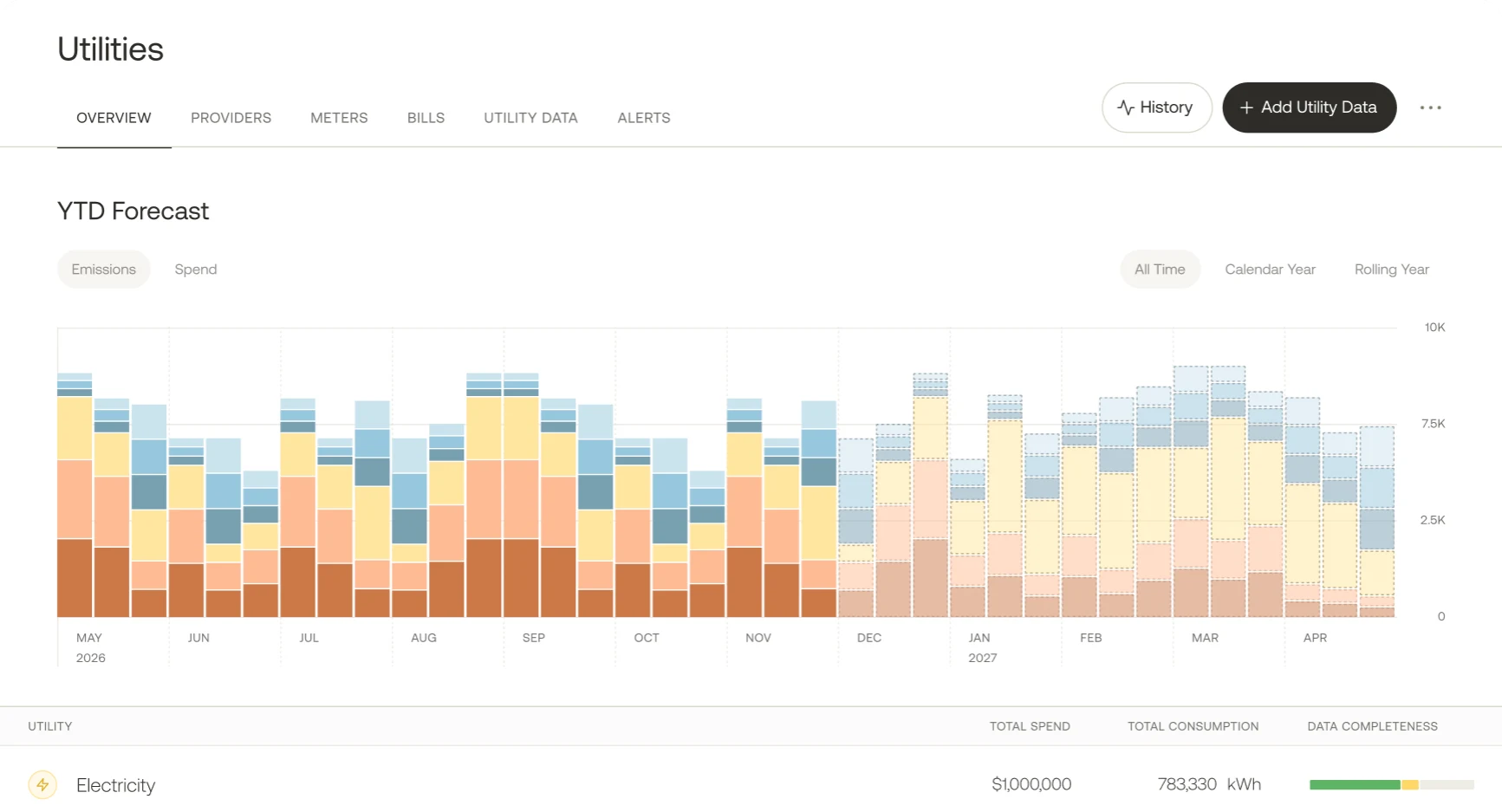
Energy budgets are set long before the bills arrive, and a single rate increase, new facility, or efficiency project can move the number materially. Gravity's new forecasting experience in Utility Bill Management lets teams model these changes in advance:
- Build a nuanced forecast. Model changes to rates, consumption, or spend. You can have each change begin in a specific month or ramp gradually over the year, and stack as many assumptions as you like.
- Scope your forecast to what matters. Build a model for a single site, commodity, or set of meters.
- Save and revisit multiple scenarios. Create and save named forecasts so you can hold a base case and an upside case side by side instead of rebuilding.
- Check against last year. Compare data against prior years from any chart, including the overall change and month-level detail.
- Take the forecast with you. Export results to Excel for board presentations, budget models, and anything else that lives outside the platform.
What Else is New
- New Utility Bill Management Insights: Gravity now surfaces utility rate changes, so you know when and why your energy costs are shifting and can plan accordingly.
- Utility Bill Management Enhancements: Get inbox notifications when new insights are ready, download source bills in bulk, track cost per unit on the new rate tab, and review data by site or by commodity.
- AI Agent for CDP Reporting: Delegate qualitative CDP questions to an agent that draws on CDP's own guidance and scoring criteria, and ask how an answer affects your score. Quantitative metrics come with methodology notes.
- SECR Reporting: UK reporting teams can now generate a complete Streamlined Energy and Carbon Reporting report from the reports page, with a guided questionnaire, embedded guidance, AI assisted answers, and a full audit trail.
- Persistent, Shareable Table Views: Filters, sorting, and page position now persist as you navigate Gravity, and a filtered table view can now be shared with its URL.
- Multiple Instances Across Browser Tabs: Users managing more than one Gravity instance can keep each one open and active in a separate browser tab, and share links to specific sub organizations and pages.
- Choose Your Global Warming Potential Values: Report using the IPCC assessment report version your framework or auditor expects, and download emissions broken out by individual greenhouse gas.